
The Boy Who Stood Up Again
The Boy Who Stood Up Again
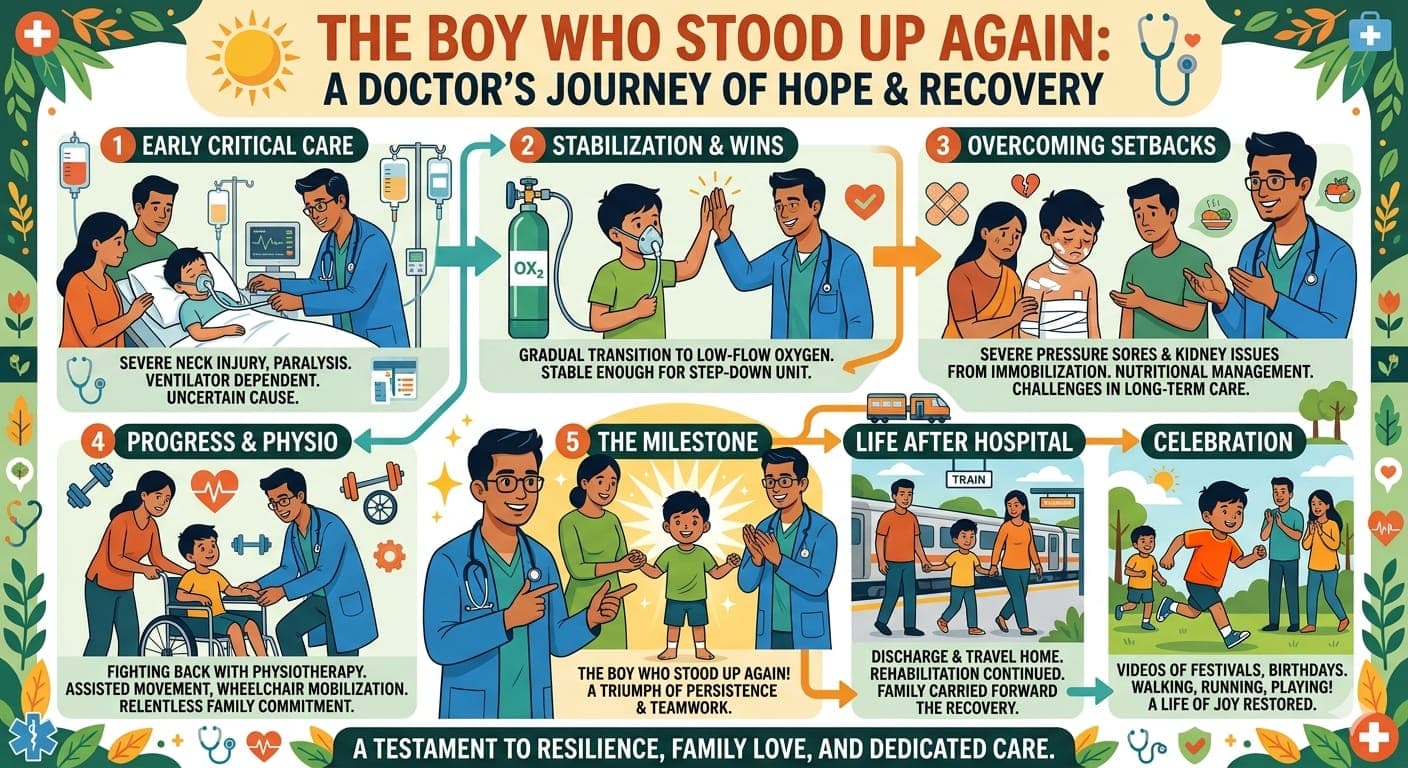
There are some patients a doctor never forgets. Not because of the complexity of medicine alone, but because of the extraordinary resilience that unfolds quietly over weeks and months — in hospital rooms, rehabilitation wards, and in the unwavering determination of a family.
— By Dr. S. Dhruva, Consultant Pediatrician
Early in my medical career, a child was brought to our hospital after suffering a severe neck injury. He was only eight years old. The exact cause of the injury remained uncertain, but the damage was devastating. He had already undergone surgery at a major tertiary care center before being referred to us for long-term critical care and rehabilitation.
When he arrived, he was dependent on a ventilator. The spinal injury had left him paralyzed, and his condition was fragile. The days that followed were filled with difficult decisions, constant monitoring, and a treatment plan that required patience from everyone involved.
Managing such cases is rarely straightforward. He needed prolonged respiratory support, careful steroid therapy, and gradual transitions between ventilator assistance and high-flow oxygen support. Some of the specialized equipment required for his care was not immediately available and had to be procured separately. Progress came slowly — measured not in dramatic moments, but in small victories.
After nearly three weeks, he improved enough to move to low-flow oxygen support. A couple of weeks later, he was stable enough to be shifted out of intensive care. It felt like a turning point.
But recovery from prolonged immobilization brings its own battles.
Like many critically ill patients confined to bed for long periods, he developed severe pressure sores. Every setback delayed rehabilitation and threatened to undo days of progress. Treating those complications became a challenge of its own. Around the same time, nutritional therapy led to kidney-related complications, which also needed careful management.
“Yet the child continued to fight. And so did his parents.”
Throughout the entire journey, they followed every medical instruction with extraordinary discipline and trust. They learned procedures, adapted to routines, and became active participants in their child's recovery. In many ways, they became part of the treatment team itself.
Gradually, physiotherapy began showing results:
- 🔹 First came assisted movement.
- 🔹 Then wheelchair mobilization.
- 🔹 Weeks later came supported standing.
And one unforgettable day, the child stood up.
For everyone involved in his care, it was more than a medical milestone. It was the culmination of months of persistence, setbacks, hope, exhaustion, and teamwork.
A few days later, he was discharged and traveled back home with his family by train to a remote part of northern India. Even after leaving the hospital, the rehabilitation continued. His parents carried forward every exercise and every lesson they had learned during the hospital stay.
Months passed. Then came the updates. Videos during festivals. Birthday celebrations. Clips of him walking. Then running. Then playing like any other child his age.
Today, he lives a life that once seemed almost impossible during those early days in intensive care.
Medicine played its role, certainly. So did surgery, critical care, rehabilitation, and physiotherapy. But stories like this are also reminders that healing often depends on something beyond hospital walls — the relentless love and commitment of family.
As doctors, we guide treatment. We make plans. We intervene when we can. But sometimes, it is the courage of patients and the endurance of caregivers that truly carry recovery forward.
And every now and then, seeing a child run again is enough to remind you why you chose this profession in the first place.